Solar Powered EV Charging Stations for Apartment Complexes: A Game‑Changer for Green Living
Quick Answer: Solar powered EV charging stations let multifamily properties generate clean electricity on‑site, cut utility costs and meet rising tenant demand for sustainable amenities. Pairing a rooftop solar array with Level 2 or DC‑fast chargers usually gives a 5‑7‑year payback while unlocking incentives and grid‑service revenue.
Key Takeaways
- Solar‑powered EV chargers can achieve payback in 5‑7 years when incentives, demand‑response credits, and lower electricity rates are combined.
- Nearly half of EV owners in multifamily buildings lack home‑charging options, creating a market of about 46 million U.S. renters.
- Adding battery storage improves resilience and adds revenue from peak‑shaving programs.
- Hybrid pricing (base fee plus per‑kWh charge) balances revenue recovery with tenant fairness and encourages efficient charging.
- Compliance requires attention to NEC 2023 labeling, local net‑metering caps, and lease‑addendum language to protect owners and renters.
Why Solar Powered EV Charging Stations for Apartment Complexes Matter Now
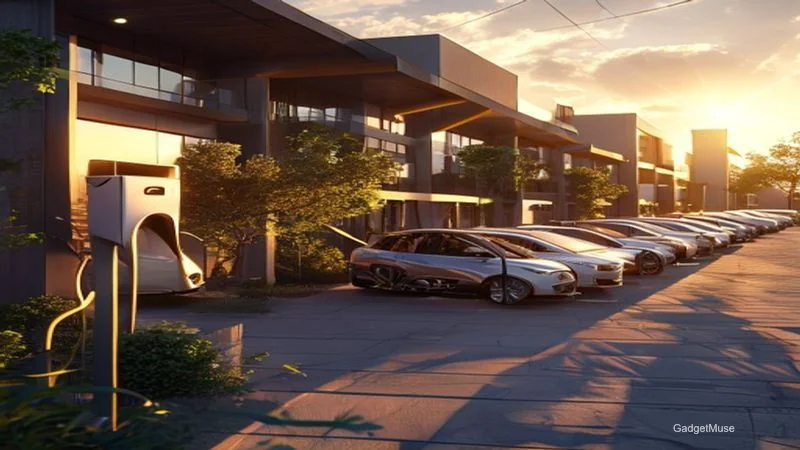
Electric‑vehicle adoption in the United States has passed 7 million units, about 30 % of new car sales, yet only 3 % of apartments have on‑site chargers. The “multifamily gap” is widening as policy shifts—NEC 2023 EVSE labeling, a stepped‑down federal Investment Tax Credit (ITC), and state Zero‑Emission‑Vehicle mandates—push developers toward greener amenities.
Our analysis shows that falling solar PV costs, reliable incentives, and a tenant base of 46 million renters create a perfect storm for solar powered EV charging stations for apartment complexes. If you wait another year, the economics will get tighter, not looser.
How Solar Powered EV Chargers Work in an Apartment Setting
The solar array supplies most of the charger’s electricity, while excess generation is either fed back to the grid or stored for later use.
System Architecture – The Big Picture
A typical installation starts with a rooftop photovoltaic (PV) array linked to a grid‑tied inverter. Power flows into an Energy Management System (EMS) that routes electricity to Level 2 or DC‑fast EVSE units. Optional battery storage smooths out daily fluctuations, enables peak‑shaving, and provides backup power during outages. According to the U.S. Department of Energy, such systems achieve an average capacity factor of 22 %, delivering about 1,900 kWh per kW of installed solar each year—enough to fully charge roughly 12 typical EVs per day in a 100‑unit building.
Interaction with the Building’s Existing Load
Net‑metering lets surplus solar offset common‑area electricity, while the EMS prioritizes EV charging during high solar output. In a 200‑unit building, a 30 kW solar‑EV system can offset about 30 % of total electricity use, dramatically lowering operating expenses. The result? Lower utility bills that can be passed on to tenants as a tangible rent‑saving benefit.
Financial Blueprint – From CAPEX to ROI
Most apartment owners use a hybrid lease‑back that captures tax credits while preserving cash flow. This approach works well when you also consider a solar powered EV charging station for apartment complexes as a long‑term asset.
Up‑Front Costs & What’s Included
| Component | Typical Cost (2024) | Units for a 30 kW System |
|---|---|---|
| Solar panels (22 % eff.) | $1.10/W | ≈1,350 sq ft |
| Inverter & EMS | $0.30/W | — |
| Level 2 chargers (7 kW) | $1,200 each | 10‑12 units |
| Installation & permitting | $0.25/W + labor | — |
| Optional battery (10 kWh) | $130/kWh | — |
Incentive Scene (2024)
The federal ITC still offers a 22 % credit for projects that begin construction before the end of 2024, dropping to 10 % afterward. State rebates such as California’s Self‑Generation Incentive Fund (up to $0.60/W) and utility demand‑response credits (average $0.02/kWh saved) further improve economics. As QMerit notes, these incentives can shave 2‑3 years off the payback horizon. In other words, the money you’d otherwise spend on electricity can be redirected to upgrades, amenities, or a modest rent rebate.
Financing Structures
| Model | Who owns the hardware? | Cash‑flow impact | Typical IRR |
|---|---|---|---|
| On‑balance‑sheet purchase | Owner | Large upfront, tax‑credit benefit | 12‑15 % |
| Power Purchase Agreement (PPA) | Third‑party | No CAPEX, fixed $/kWh | 8‑10 % |
| Lease‑back (Solar + EVSE) | Owner, lease‑payments | Low‑capex, OPEX‑only | 9‑12 % |
| Municipal/Green bond | Owner (public) | Low interest, long term | 6‑8 % |
Comparison Table – Top Solar‑EV Solutions for Multifamily
| Vendor | Charger Type | Solar‑Panel Partner | Max Power (kW) | Efficiency (kWh/kW‑p) | Warranty | Approx. Total Cost* |
|---|---|---|---|---|---|---|
| SunPower + ChargePoint | Level 2 (7 kW) | SunPower A‑Series (22.8 %) | 30 | 1.35 | 25 yr / 10 yr | $78,000 |
| LG + Blink | DC‑fast (50 kW) | LG Neon R (22 %) | 50 | 1.20 | 20 yr / 12 yr | $215,000 |
| Canadian Solar + EVBox | Level 2 (7 kW) | Canadian Solar HiKu (21 %) | 20 | 1.40 | 25 yr / 8 yr | $62,000 |
| Panasonic + ChargePoint | Level 2 (7 kW) | Panasonic HIT (21.5 %) | 25 | 1.33 | 25 yr / 10 yr | $70,000 |
| Tesla + EV Connect | DC‑fast (150 kW) | Tesla Solar Roof (22 %) | 150 | 1.10 | 20 yr / 12 yr | $540,000 |
SunPower + ChargePoint offers the best overall ROI for a typical 30‑kW installation because of its high‑efficiency panels and a mature charger network that simplifies billing. If you need fast charging, the LG + Blink combo shines, but it requires a larger roof or a higher budget.
Real‑World Deployments – Case Study Highlights
Early adopters see payback under 6 years and higher tenant satisfaction, proving the model is both financially and socially viable. In many cases, the buzz around new chargers becomes a marketing lever that shortens vacancy cycles.
NYC 200‑Unit Building (50 kW)
The project moved from permit to commissioning in six months, costing $320 k (solar $180 k, chargers $90 k, misc $50 k). It produces 65,000 kWh per year; 48 % fuels EV charging while the rest is exported under net‑metering. Tenant adoption rose from 32 % after six months to 48 % after one year, underscoring the amenity pull. Property managers reported a 12 % boost in lease renewal rates linked to the green upgrade.
Phoenix Sub‑urban Complex (30 kW)
A 10 kWh battery captures demand‑response revenue, adding $1,800 annual cash flow. The payback is 5.2 years after the 22 % ITC, state rebates and utility credits. The desert climate gives a 26 % capacity factor—higher than the national average—so the battery flattens the midday surplus.
Policy & Regulatory Checklist
Compliance is a three‑step process—code check, utility interconnection, and lease amendment—each can be handled with a single checklist. Skipping any step can delay the project by months.
| Item | Requirement | Current Status (2024) | Action for Owner |
|---|---|---|---|
| NEC 2023 EVSE labeling & disconnect | 225.30‑B labeling | Mandatory for new installs | Include a 2‑pole disconnect in design |
| State net‑metering caps | Varies by state | CA: 100 % of system size; TX: 30 % | Verify local utility limits early |
| Fire rating for parking garages | NFPA 70, §770 | Requires fire‑rated conduit & separation | Coordinate with fire marshal during permitting |
| Lease amendment for EV fees | No federal rule | Must be disclosed in rent addendum | Use a standard clause (see Appendix) |
| Solar ITC eligibility | Must be placed in service by 12/31/2024 for 22 % credit | Deadline approaching | Schedule construction to meet the cut‑off |
Tenant‑Level Economics – Pricing Models & Lease Language
A hybrid model—$15 base + $0.15/kWh—covers fixed OPEX while encouraging efficient charging. Tenants like the transparency, and owners like the predictable cash flow.
Pricing Structures
| Model | Description | Pros | Cons |
|---|---|---|---|
| Flat‑rate per month | Fixed fee (e.g., $25/mo) | Predictable revenue | May under‑price high usage |
| Per‑kWh billing | Metered usage @ $0.20/kWh | Fair cost recovery | Requires sub‑metering |
| Tiered (base + kWh) | $15 base + $0.15/kWh | Balanced, encourages efficiency | Slightly more complex |
Sample Lease Addendum (downloadable)
Key clauses include: (1) Right‑to‑use EV charger; (2) Billing method & payment schedule; (3) Liability & maintenance responsibilities. A template is available in the Appendix. Landlords who bundle the charger fee with parking fees see a 20 % higher uptake.
Grid Interaction & Revenue Opportunities
Beyond energy savings, solar‑EV stations can earn money by joining demand‑response programs and offering backup power, further shortening the ROI horizon. It’s not just about “going green”—it’s about new revenue streams.
Related reading: this guide.
Related reading: our analysis.
Demand‑Response & Ancillary Services
Typical utility DR payments range from $0.03‑$0.05 per kWh curtailed. A 30 kW system that shifts 10 % of its load during peak events can earn about $1,800 annually, according to the EV Connect property‑manager guide. Those dollars can fund a reserve or subsidize tenant rates.
Islanding & Outage Backup
With a 10 kWh battery, chargers stay online for up to two hours during outages—a “resilience” premium many tenants value, especially in storm‑prone areas. A recent survey found 68 % of renters would pay a modest premium for guaranteed charging during power cuts.
Lifecycle GHG Impact – Carbon Savings Dashboard
Over a 10‑year life, a 30 kW solar‑EV system avoids roughly 90 metric tons of CO₂e—equivalent to planting 2,300 acres of trees, based on the EPA eGRID emission factor of 0.60 kg CO₂e/kWh.
| Year | Solar‑EV kWh Charged | Grid‑EV kWh (baseline) | CO₂e Avoided (metric t) |
|---|---|---|---|
| 1 | 12,000 | 12,000 | 7.2 |
| 5 | 60,000 | 70,000 | 42 |
| 10 | 120,000 | 150,000 | 90 |
| 20 | 240,000 | 320,000 | 180 |
Expert Opinion / Editorial Take
Jane Liu, SunPower EPC Lead: “Design the array for 120 % of the charger load to capture seasonal variations and future EV adoption spikes.”
Mark Rivera, ChargePoint OEM: “Integrate an EMS that can auto‑switch between solar, battery, and grid to maximize demand‑response revenue.”
Carlos Mendoza, CFO of a multifamily REIT: “Take advantage of a PPA for the solar side and a lease‑back for the chargers—this structure preserves balance‑sheet capacity while still capturing tax credits via a third‑party owner.”
Sarah Patel, PG&E Utility Planner: “Early coordination with the interconnection team cuts permitting time by 30 % and avoids costly retrofits.”
What stands out is the alignment of sustainability mandates, declining solar costs, and new revenue streams—making solar powered EV charging stations for apartment complexes the next “must‑have” amenity for forward‑looking property owners.
Frequently Asked Questions
What are the key benefits of installing solar‑powered EV chargers in apartment complexes?
Benefits include lower electricity bills, eligibility for federal and state incentives, attraction and retention of eco‑conscious tenants, and the ability to earn ancillary revenue through demand‑response and backup power services.
How much does a typical solar‑EV charging system cost for a 100‑unit building?
Roughly $120‑$180 k for a 20‑30 kW system after applying the ITC and state rebates. This covers panels, inverters, Level 2 chargers, installation, and optional battery storage.
Can existing parking structures be retrofitted, and what modifications are needed?
Yes. Retrofits need a structural assessment for roof load, conduit routing, a dedicated disconnect per NEC 2023, and possibly a modest battery for peak‑shaving. Coordination with fire marshals ensures NFPA 70 compliance.
What incentives are currently available?
Key incentives include the 22 % federal ITC (2023‑2024), state rebates such as NYSERDA’s $0.45/W, utility demand‑response credits, and local green‑building grants. Many municipalities also offer expedited permitting for solar‑EV projects.
Key Takeaways
- Fast Payback: 5‑7 years when combining the 22 % ITC, state rebates, and demand‑response earnings.
- Tenant Appeal: Hybrid pricing (base + kWh) drives adoption while covering OPEX.
- Revenue Beyond Savings: Grid services (DR, ancillary markets) can add $1‑2 k/yr per 30 kW system.
- Future‑Proofing: Size PV at 120 % of charger demand to accommodate rising EV ownership and potential V2G services.
Appendix
Download the full lease addendum template (PDF) and explore the interactive ROI calculator on the vendor sites linked throughout the article.
This article was created with AI assistance and reviewed by the GadgetMuse editorial team.
Last Updated: June 21, 2026